Media · off the glass
The briefing, on one stage.
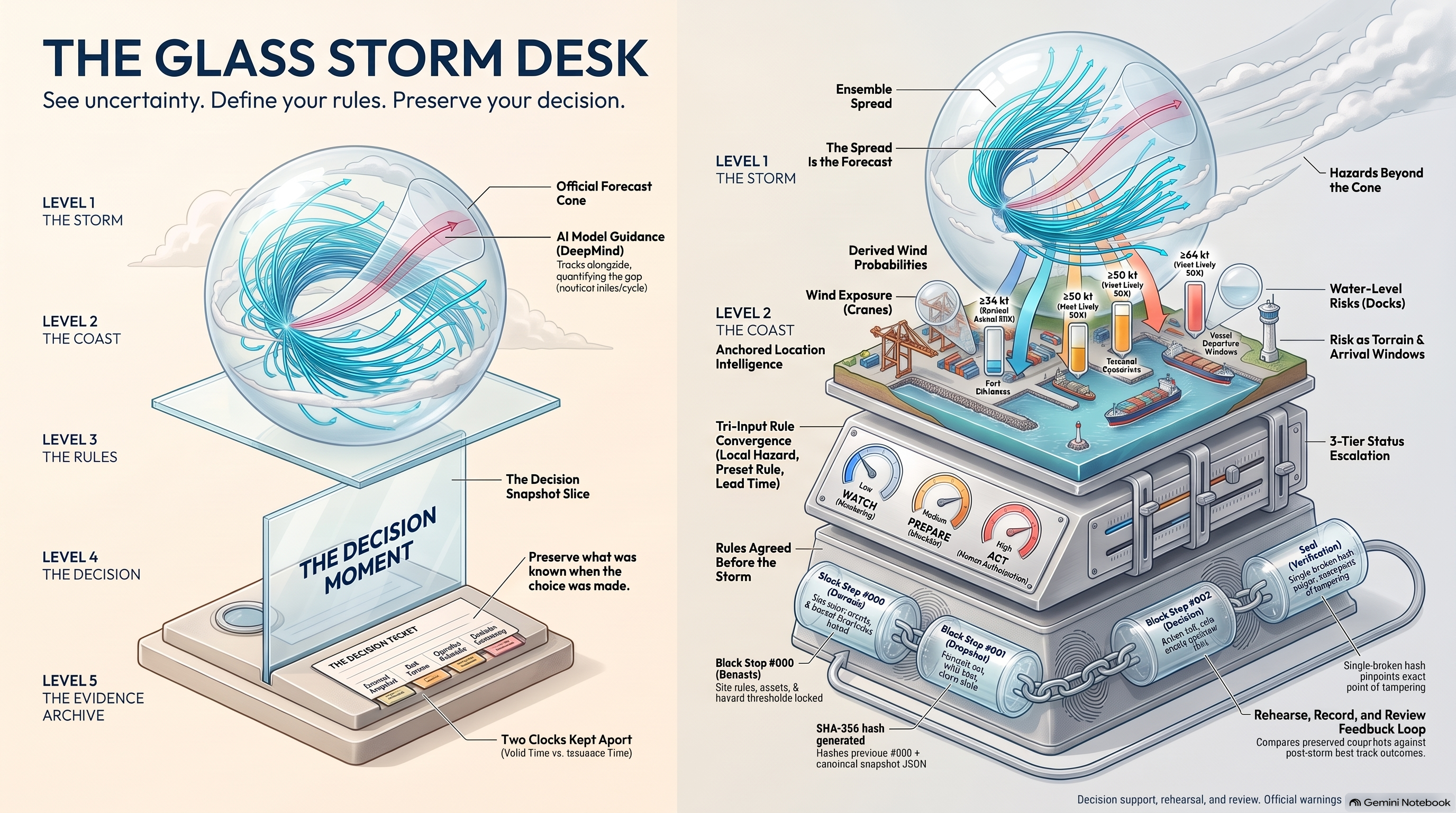
The same voice as the introduction. The spread, the two clocks, the seal, the 2026 snapshot, and the limits.
The Glass. Read the glass. Record the call.
This is a briefing for the person who has to decide while the storm is still a forecast. A harbor. A port. A resort. A ferry. People and equipment at a real place, and a rule written before the wind arrived.
A storm does not arrive as a single line. It arrives as a spread. The ensemble. The official cone. And the track beside them.
On the glass, every thread is one ensemble member, coloured by the wind it carries. Where the threads bunch, the future is settled. Where they fan, it is not. The official forecast rides inside a cone. The radii on this desk approximate the published two-thirds circles. They are not the National Hurricane Center graphic. Beside the cone, in rose, is the Google DeepMind track filed as guidance. The desk states the gap between them, in nautical miles, every cycle.
There are two clocks, and they are kept apart. Valid time is the hour you are inspecting. Issuance is what the forecast said when you were looking. You can scrub the valid time. You can step back through every issuance. A later run does not get to rewrite an earlier decision.
Then you seal the call. The thresholds are hashed before the first decision, so the goalposts cannot be moved afterwards. Every decision carries the forecast that was on the glass. Each block is a SHA-256 hash over the previous hash and a canonical body. Change one block, and every later hash breaks.
The harbors, the ports, and the islands are where the map says they are. The cranes, the ferries, the guests, and the rules ship as a rehearsal. Replace them with yours. Each site is a few lines of JSON. The desk turns the ensemble into a probability, and it calls a state. Clear. Watch. Or act.
Three storms from 2026 are built into the page. Polo. Nolo. And Fay. Taken from National Hurricane Center a-decks on the twenty-eighth of September, 2026, at eleven forty-five UTC. They are not a live picture of the ocean. A storm is live only when the desk says so, and only when the deployed feed answers.
Now the limits, at the same volume as the rest.
This desk does not issue watches or warnings. Those belong to the National Hurricane Center, the Central Pacific Hurricane Center, and the National Weather Service.
GEFS winds are scaled so their mean follows the official intensity, because the ensemble under-resolves the peak. The site probabilities that come from that are not official hazard probabilities.
The hash is real. The field names in the evidence envelope are a best guess at the studio layout. If a verifier expects different keys, there is one function to change.
Not a warning. A record of the call.


